People usually notice the color first. Put a dark piece of ebony beside a wildly figured piece of ziricote and the conversation quickly turns to which one looks better. That is understandable. A handmade wooden slingshot is a small object, so the grain has nowhere to hide.
But appearance is not where I would start.
The first question is whether the particular piece of wood suits the frame. Not the species in general—the actual piece on the bench. Two boards carrying the same name can behave very differently. One may have straight, quiet grain running cleanly through the whole outline. The other may contain a small check, an abrupt grain change, or a beautiful patch of figure in exactly the wrong place.
For a working slingshot, the less glamorous details matter most.
Start with the grain, not the price tag
A slingshot frame is pulled repeatedly through the tips, shoulders, and handle. Those transitions need continuous grain and enough material around them. If the grain runs out across a narrow section, rarity and price do not make the wood a better choice.
This is why a promising blank often gets turned around several times before a frame outline is drawn. The prettiest face may not be the useful face. Sometimes shifting the pattern by a few millimeters gives the grain a cleaner path through one tip. Sometimes the right decision is to save that blank for another project.
Look closely at both faces and all four edges. Check for hairline cracks, bark inclusions, knots, and sudden changes in direction. End grain is especially informative. It can reveal lines that are easy to miss on a polished surface.
There is no substitute for this inspection. “Exotic hardwood” is a category, not a guarantee.
Ebony makes a compact frame feel substantial
Ebony is an obvious choice for a premium handmade wooden slingshot. It is dark, fine textured, and dense enough to give a small frame a reassuring weight. Once properly sanded, it can feel remarkably smooth without needing a thick glossy finish.
That density comes with trade-offs. Ebony rewards sharp tools and an unhurried approach. It also makes every extra bit of bulk noticeable in the hand. A shape that feels balanced in walnut can feel unnecessarily heavy when copied directly in ebony.
The best ebony frames tend to let the material do what it is good at: stay compact, hold crisp lines, and finish cleanly. Subtle brown streaks or lighter areas are not flaws. They are part of the tree, and often make the finished piece more interesting than a perfectly uniform black surface.
If you like a smaller slingshot with a solid feel, ebony is worth considering. If you prefer a large, full grip, a lighter wood may be more comfortable over a long practice session.
Ziricote needs a little restraint
Ziricote is harder to ignore. Its dark, wandering lines can look like a landscape drawn across the wood. No two pieces are quite the same, which is exactly why it works so well for a one-off custom wooden slingshot.
The temptation is to chase the most dramatic figure. That can be a mistake.
Figure tells you what the surface looks like; it does not automatically tell you how the grain travels through the frame. The layout still has to make structural sense. A quieter section with better continuity is usually the wiser choice for a tip or shoulder than a spectacular swirl with uncertain grain beneath it.
Ziricote also does not need much decoration. Careful shaping, patient sanding, and a restrained hardwax finish are usually enough. A heavy coating can flatten the natural contrast and make a wooden grip feel more like molded plastic.
Walnut and maple should not be overlooked
Exotic species get most of the attention online, but rarity is not a performance specification. Good walnut is pleasant to shape, warm in the hand, and lighter than ebony. It suits a larger grip without turning the finished slingshot into a pocket weight.
Maple offers a clean surface and predictable feel, particularly in laminated frames. Dense fruitwoods can also be excellent when properly dried. Pear, plum, and similar woods often have fine grain and understated color that improves with use.
The practical lesson is simple: a sound piece of ordinary-looking hardwood is better than a questionable piece with an impressive name.
Density changes the design
When people ask about the best wood for a slingshot, they often expect a list ranked from strongest to weakest. That is not very useful. The design and the material have to be considered together.
A dense wood allows a compact frame to feel planted in the hand, but the edges and grip still need to be comfortable. A medium-density wood can support a fuller, more rounded handle without adding too much weight. Laminated construction opens another set of options, provided the mating surfaces, adhesive, clamping, and curing are all handled correctly.
The Desert Ironwood Flying Tiger slingshot is one example of a dense hardwood used in a compact, hand-shaped frame rather than carried over from a lighter-wood pattern.
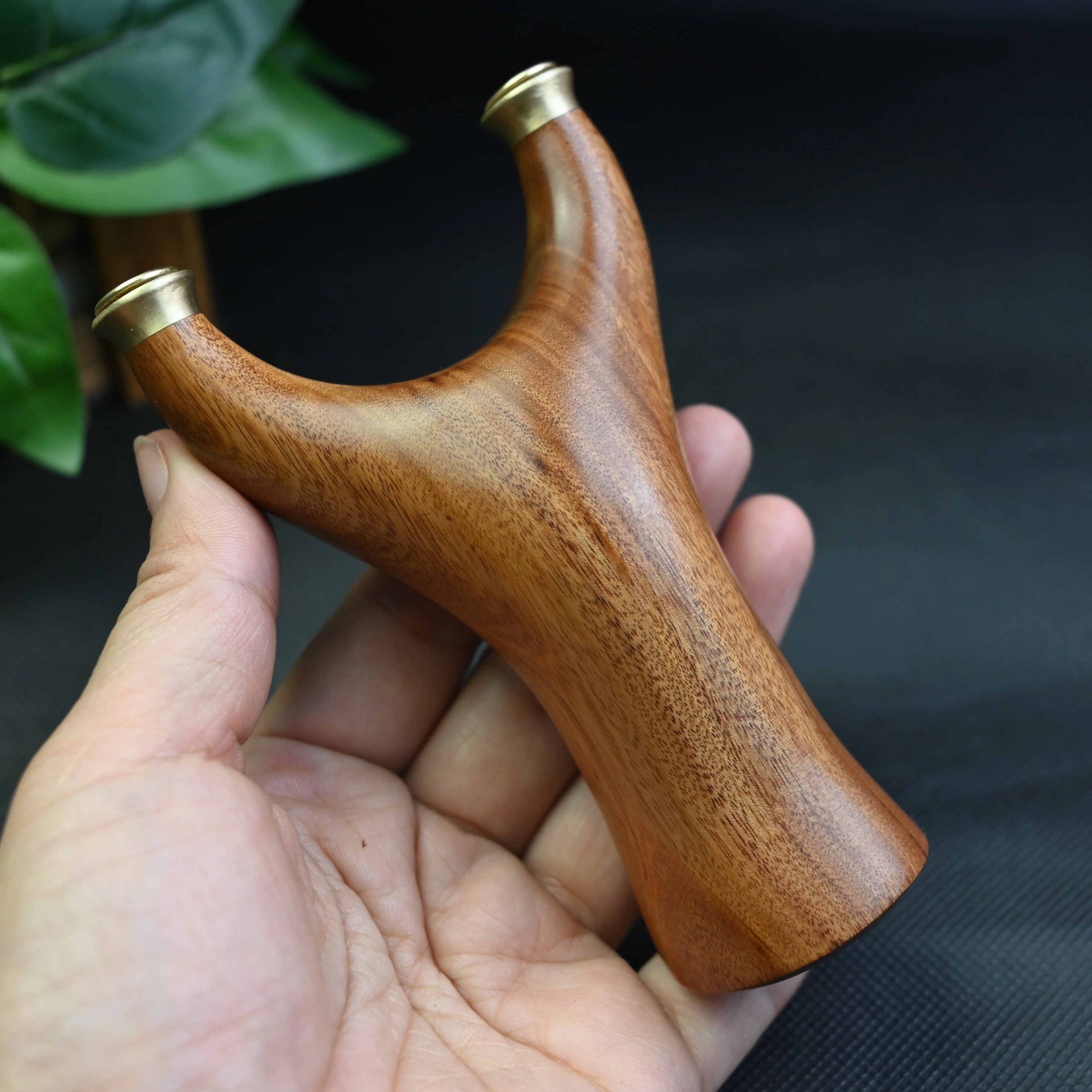
This is also where asymmetry can help. A frame shaped specifically for the left or right hand does not need to carry equal material everywhere. It can be fuller where the palm needs support and slimmer where the fingers need clearance. The result should settle into the hand naturally, without forcing the wrist into position.
Finish should protect the wood, not bury it
A wooden slingshot is handled constantly. The finish needs to cope with skin oils and occasional moisture while preserving a secure grip.
Oil and hardwax finishes are popular because they leave the surface feeling like wood. They are also easier to refresh than a thick film finish. Whatever finish is used, it should be completely cured before bands are fitted or the frame is handled for long periods.
Care is straightforward. Keep the frame dry, do not leave it baking in a car, and wipe it down after outdoor use. Check the wood around the band attachment areas regularly. Any new line, movement, or sound is a reason to stop and inspect the frame rather than take another shot.
So, which wood would I choose?
For a compact frame with a dark, understated appearance, ebony is difficult to beat. For a one-of-one piece where the grain is part of the design, ziricote has real character. For a larger and lighter grip, walnut deserves serious consideration.
Still, I would choose a clean, well-oriented blank over a fashionable species every time.
The best wood for a handmade slingshot is not simply the hardest, darkest, or most expensive. It is the piece with sound grain, suitable weight, enough material in the right places, and a shape that feels settled in the hand. Everything else comes after that.
Always inspect the frame and bands before use, wear eye protection, use a secure backstop, and follow the laws where you live.