An 85 mm wooden slingshot is 5 mm wider across the outside of its fork tips than an 80 mm frame. That difference does not automatically mean a wider inner gap, a larger handle, or better performance. Tip width and the full frame profile must be compared as well. Our 85 mm solid-wood frame has 18 mm tips; the 80 mm Flying Tiger has 14 mm tips, and the 80 mm Large Mantis has 17 mm tips.
Five millimetres sounds like a small change. On a handheld object, it is visible, but it still tells only part of the story. Two frames can gain width in quite different places: one spreads the tips farther apart, while another carries more wood in each tip.
If you are choosing between these sizes online, start with the measurements rather than treating 85 mm as the next step up from 80 mm.
Three frames, three sets of proportions
| Listed frame | Outer fork width | Fork tip width | Overall height |
|---|---|---|---|
| Flying Tiger round-tip | 80 mm | 14 mm | 120 mm |
| Large Mantis | 80 mm | 17 mm | 130 mm |
| Sculpted solid-wood frame | 85 mm | 18 mm | Confirm by email |
These are published dimensions for the particular pieces in our collection. They are not a sizing standard that applies to every frame carrying the same pattern name.
The missing height on the 85 mm listing is worth noticing. It should be measured and confirmed if overall scale matters to your choice. A photograph can show proportions without supplying a reliable absolute measurement.
Outer width is not the same as clear space
Imagine keeping the outer width fixed and making both tips wider. More material would extend into the opening, leaving less clear space between them. That is why outside width alone cannot tell you the fork gap.
It is tempting to calculate the gap by subtracting both tip widths from the outer width. On a simple drawing with straight, parallel measurements, that can describe the geometry. On a carved frame, the tip faces may be rounded or angled, and the widest outside points may not lie on the same measurement line as the inside edges.
Ask for the actual clear gap if it is important to you. Do not convert approximate catalogue measurements into a precise gap that has never been measured.
Our guide to 80 mm fork width explains the measurement terms in more detail.
What the 85 mm frame offers visually
The 85 mm sculpted solid-wood slingshot has broad shoulders, rounded flared tips, and a strongly shaped handle. Its red-brown grain follows the changes in surface, making the side views particularly useful when judging the palm swell.
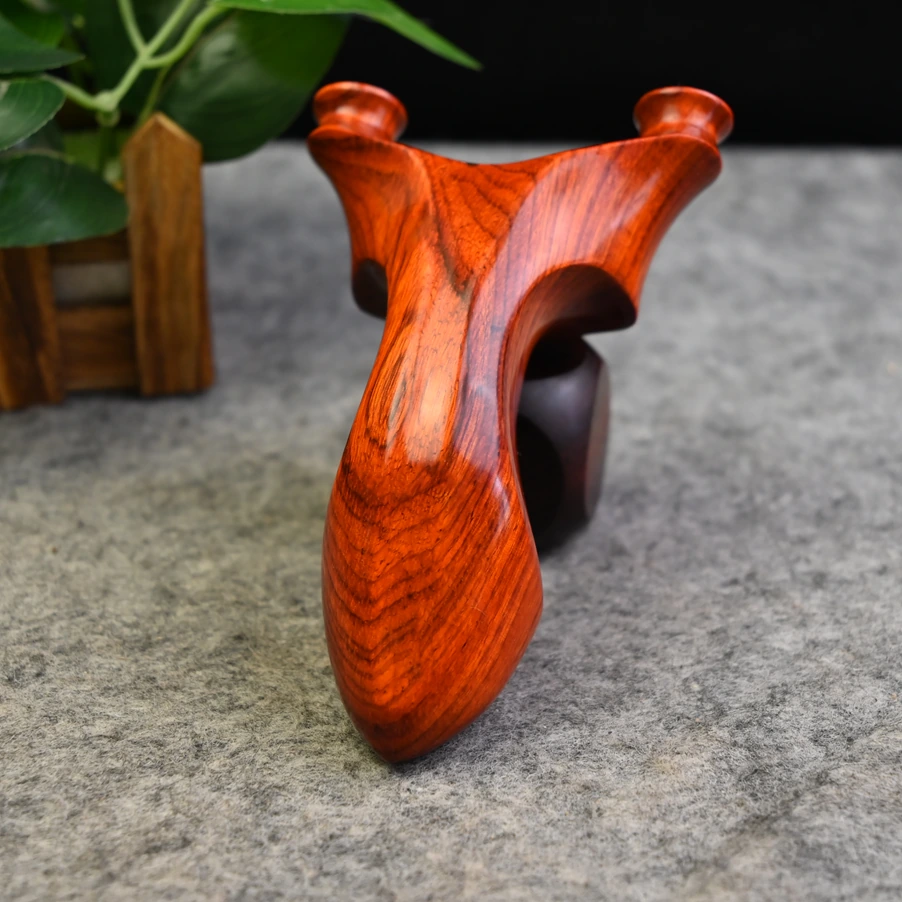
Its wider upper outline may appeal to someone who prefers substantial shoulders. That is a design preference, not evidence that it will suit every larger hand. The position of the waist and the depth of the handle remain separate questions.
An 80 mm frame can still have a full handle
The Large Mantis is a useful counterexample to the idea that outside width determines grip size. It stays at 80 mm across the tips but carries a rounded palm swell and a 130 mm overall height.
The Flying Tiger round-tip shares that outside width while using a shorter, more defined waist and narrower tips. Those two 80 mm frames may be a more meaningful grip comparison than simply choosing between the numbers 80 and 85.
If those patterns interest you, read the Flying Tiger versus Large Mantis comparison.
Wider tips do not prescribe stronger bands
An 18 mm tip describes a surface dimension. It does not specify the latex thickness, taper, active length, or draw demand that should be used. Nor does it establish the intended attachment method.
Confirm how the bands should sit on the exact frame. Rounded wooden tips and fitted brass plates should not be treated as identical systems simply because their widths are close. Ask for an attachment close-up if the gallery does not resolve the question.
Band selection belongs to the complete setup and the user’s measured draw length. More space at the tip is not an instruction to fit the widest or heaviest band available.
Which width should you choose?
If you already own a comfortable frame, compare its outside width, tip width, overall height, and side profile with the candidate. Keep the measurements separate in your notes. A familiar handle can tell you whether a fuller palm swell is desirable; outside width cannot answer that alone.
If you have no reference frame, ask for the missing dimensions and intended holding hand. Look at both faces and both sides before deciding. With asymmetric woodwork, a curve facing the wrong direction can matter more than a 5 mm width difference.
The solid-wood slingshot buying guide brings grip, material, and attachment style into the same decision. Choose the piece whose proportions you can understand, then confirm availability and order details by email.
Inspect the frame and bands before use, wear eye protection, use a secure backstop, and follow local law.