Amber tying tape is a narrow, flexible strip used to secure slingshot flat bands at suitable attachment points. It is binding material, not the working band that stores energy during the draw. Zenith Fork Studio offers it in 20 m rolls at USD 12.80 per roll; confirm compatibility with your frame and band attachment before ordering.
The name can be confusing in an English product listing. “Amber band” sounds as though it describes the colour of a shooting bandset. In this case, it refers to the smaller tying material wound onto a spool. It has a different job from the two broad strips running between the frame and pouch.
That distinction is worth making before comparing prices. A roll of binding material and a pack of ready-made flat bands are separate workshop supplies.
What the tying tape actually holds
In a traditional wrap-and-tuck attachment, a narrow strip wraps around the fork tip and the main flat band. The final end is tucked beneath an earlier turn to retain the wrap. The main band needs to remain aligned and supported against a smooth contact surface.
The tying material provides the binding. It does not correct a chipped fork tip, an uneven edge, or a band placed in the wrong direction. Those details need attention before wrapping starts.
Our wrap-and-tuck attachment guide covers the preparation and inspection involved. If your frame uses a screw-down cap, follow the maker’s attachment instructions instead of assuming extra wrapping is required.
What a 20 m roll includes
The Amber Band-Tying Tape — 20 m Roll is sold as one spool of tying material. The photographs show several spools together and an unwound section so the translucent strip is easier to see. The listed USD 12.80 price is for one roll, not the group in the photograph.
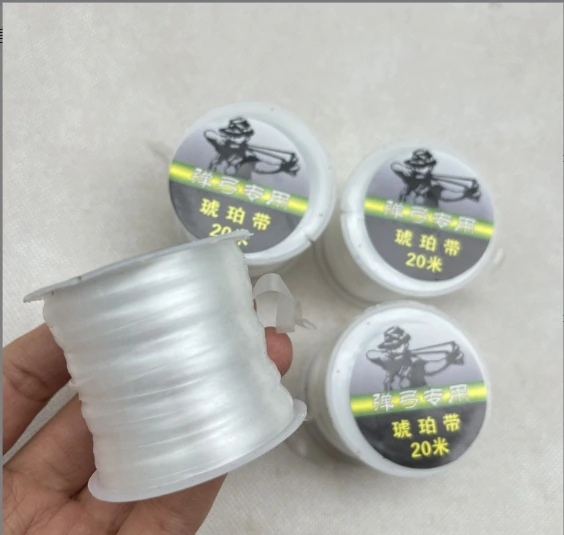
A spool lets you cut material as needed rather than keeping a collection of short lengths. Keep the loose end accessible and protect the roll from workshop dust. A strip that has picked up abrasive particles should not be wrapped against clean latex.
Tying tape and flat bands are not interchangeable
The working flat bands are selected around the complete setup, including latex type, thickness, taper, active length, pouch, and the user’s draw length. Binding tape is selected for its attachment role.
Buying a long roll of tying material does not supply replacement shooting bands. If you need the broad strips and pouch as an assembly, look at the separate tapered flat bandsets.
Likewise, do not assume that any elastic strip can replace a tying material. Width, thickness, surface grip, and condition affect how a wrap sits. Use material intended for the attachment and ask about compatibility when the dimensions are not supplied.
What to confirm before ordering
The product photographs establish appearance and packaging, but they cannot establish every technical property. Our listing does not currently specify the strip’s exact width, thickness, or polymer composition. If you need it to match an existing tying material, ask for those details before payment.
Send the frame name or a close photograph of the tip, and explain what you intend to attach. A question such as “Will this suit the traditional tips on this frame?” gives us something specific to check. “Will it work on every slingshot?” does not: attachment surfaces and hardware vary too much.
For a wooden frame, inspect the contact area first. Smooth, rounded edges matter because the main band is repeatedly stretched near that point. More turns of tape cannot make an unsuitable surface acceptable.
Keep the roll clean between band changes
Store tying material without tension and away from direct light, prolonged heat, oils, and household cleaning products. A clean closed bag or drawer helps keep grit off the strip. Keep it separate from used ties and workshop offcuts so damaged material does not find its way back into a new attachment.
There is no fixed replacement interval stated for this product. Inspect it when cutting a new length. Discard sections with cuts, cracking, contamination, or an unexplained change in feel rather than building a fresh attachment around questionable material.
The broader latex band storage guide explains why keeping elastic supplies away from heat and light is a useful workshop habit. It does not establish a material specification or shelf life for this tying tape.
How many ties will one roll make?
That depends on the length used per attachment, the size of the tips, and the wrapping method. We do not quote a fixed number of band changes per spool because those details vary.
If you already know the length you use for one tie, divide the roll length by that figure to estimate the number of individual ties. Remember that changing a pair of bands may involve more than one attachment, and allow for trimming or discarded sections. Twenty metres describes the supplied length, not a guaranteed number of completed bandsets.
A small supply worth describing accurately
Tying tape rarely gets the attention given to figured hardwood or polished fork tips, yet it is something owners of traditional frames handle regularly. A useful listing should say what it is, how much is supplied, and which details still need confirming.
For this roll, the essentials are straightforward: translucent binding material on a plastic spool, 20 m per roll, sold individually. If you are unsure whether it suits your attachment, email Zenith Fork Studio with the frame details before ordering.
Inspect the completed attachment, frame, and bands before use. Wear eye protection, use a secure backstop, and comply with local law.