Draw length is often discussed as if it were a fixed property of the slingshot. It belongs to the person using it. The frame establishes the band attachment point, but posture, anchor point, and arm position decide how far the pouch actually travels.
Measuring that distance is useful when comparing replacement bands. It gives you a repeatable starting point and helps explain why a bandset that feels comfortable for one person may feel completely different for another.
What draw length means
For a handheld slingshot, draw length is the distance from the band attachment line at the frame to the pouch at the user’s normal anchor point. It is measured along the direction of the draw, not around the body and not as a straight arm-span estimate.
Your anchor point might sit near the cheek, jaw, or another consistent facial reference. The important word is consistent. If the pouch stops in a different place each time, a precise number written in a notebook will not describe the real setup.
Draw length is not the same as active band length. Active band length is the working latex between the fork attachment and the pouch tie. Parts held beneath a clamp or wrapped around the tip are not active.
Measure without drawing a live bandset
The simplest method uses a non-elastic cord. Fit or hold one end at the approximate attachment line of an unloaded frame. Take your normal stance, extend the frame arm without locking it rigidly, and bring the other end to your normal anchor point.
Have another person mark the cord, then measure it on a table. Repeat the process several times. If the marks vary widely, work on finding a comfortable repeatable posture before selecting band dimensions.
Do not improvise by drawing damaged latex or an unknown heavy bandset to your face. The purpose of the cord is to measure without storing elastic energy.
Keep the frame orientation consistent
Rotating the wrist or changing from a high pinch grip to a lower palm-supported grip can move the attachment line. The difference may be modest, but it matters when you are trying to compare measurements.
Use the frame in the orientation you actually intend to hold. If you are still deciding between grips, our comparison of pinch grip and thumb support explains how handle shape affects that choice.
The outer fork width does not directly determine draw length, although it changes the geometry at the front of the setup. Frame measurements and user measurements should remain separate in your notes.
Active band length is a setup decision
Once draw length is known, active band length can be selected within the guidance supplied for the particular latex. There is no responsible universal ratio for every material. Different latex formulations and thicknesses have different working ranges, and temperature or age can change how they feel.
Start conservatively. A band that is cut too short may feel harsh and experience unnecessary stress. Longer is easier to shorten after careful testing; latex removed from an over-short band cannot be restored.
If you buy finished replacement bands, tell the maker your measured draw length and the attachment style of the frame. That information is more useful than saying you want the “fastest” setup.
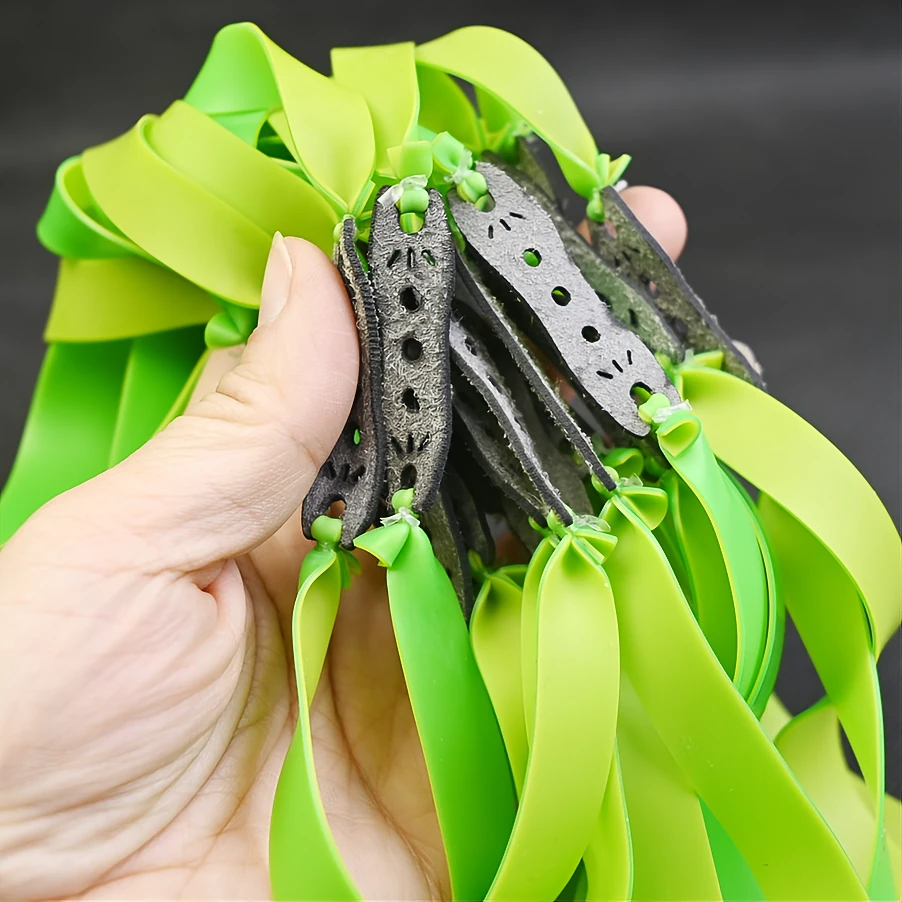
Record the details that affect comparison
A useful setup note includes the date, frame, attachment style, latex type and thickness, taper, active length, pouch, and measured draw length. That may sound excessive, but it prevents two visibly similar bandsets from being treated as identical.
Record comfort as well. A setup that can be drawn once is not necessarily one that can be controlled repeatedly. If the shoulders rise, the wrist twists, or the anchor point shifts under strain, reduce the demand rather than forcing the measurement.
Recheck after changing posture or frame
Draw length can change when you move to a different anchor point, alter stance, or use a frame with a different grip position. It is worth measuring again rather than assuming the old number still applies.
The same is true after a long break. Comfort and mobility change. A safe, moderate setup based on your current movement is more useful than reproducing an old measurement for its own sake.
Measuring slingshot draw length is not about finding the largest number. It is about replacing guesswork with a repeatable reference so the frame and bands can be discussed clearly.
Inspect the complete setup before use, wear eye protection, use a secure backstop, and follow local law.