When ordering an asymmetric wooden slingshot, identify the hand that holds the frame and the hand that draws the pouch. Sellers may use “left-handed” differently, so spell out both actions. Then confirm that the palm swell, thumb support, and finger clearance of the exact frame suit your holding hand.
“I’m right-handed” sounds like enough information until two people interpret it differently. One means the hand doing the pulling. Another means the hand wrapped around the wooden handle. On a symmetrical frame the confusion may pass unnoticed. On a strongly shaped grip it can leave the comfortable surface facing the wrong direction.
Describe the action, not just the label
A clear inquiry says: “I hold the frame in my left hand and draw the pouch with my right.” Reverse those words if that describes your usual hold. That sentence is more useful than either a left-handed or right-handed label on its own.
Do not change a familiar hold just to match a product description. If you are choosing your first frame, discuss the intended setup before ordering rather than relying on writing-hand preference alone. Comfort, visual alignment, and consistent movement all deserve attention.
What makes a wooden grip asymmetric?
A frame can have matching fork tips while its handle is shaped differently on each side. The palm swell may project more on one face. A thumb shelf may sit under one shoulder. A shallow finger relief may remove wood from the opposite edge.
Those changes can give the hand a repeatable resting place. They can also make a frame less comfortable when reversed. The degree varies: a subtle swell may be usable in either hand, while a pronounced shelf may clearly favour one orientation.
This is why a front photograph cannot establish handedness reliably. It shows the outline but hides the depth and the surfaces that actually contact the palm.
Which photographs help most?
Look at the front, reverse, both sides, and an angled view from below the handle. Follow the handle from the narrow waist toward the base. Where does it become thicker? Is the fuller face intended to sit against the palm, and is there clearance for the fingers on the other side?
If a thumb support is visible, ask how the maker intends it to be used. Do not infer the answer solely from the direction the frame faces in a product photograph. Images are often rotated for composition, and a mirrored image would reverse apparent handedness entirely.
For an online purchase, a brief explanation of the intended hold is more helpful than a dozen decorative close-ups.
A fuller handle is not automatically ambidextrous
The Large Mantis solid-wood slingshot has broad shoulders and a rounded palm swell. These make its side profile especially useful to examine. Its 80 mm outer width, 17 mm tips, and 130 mm height describe scale, but none of those numbers specifies which hand the asymmetric grip fits.
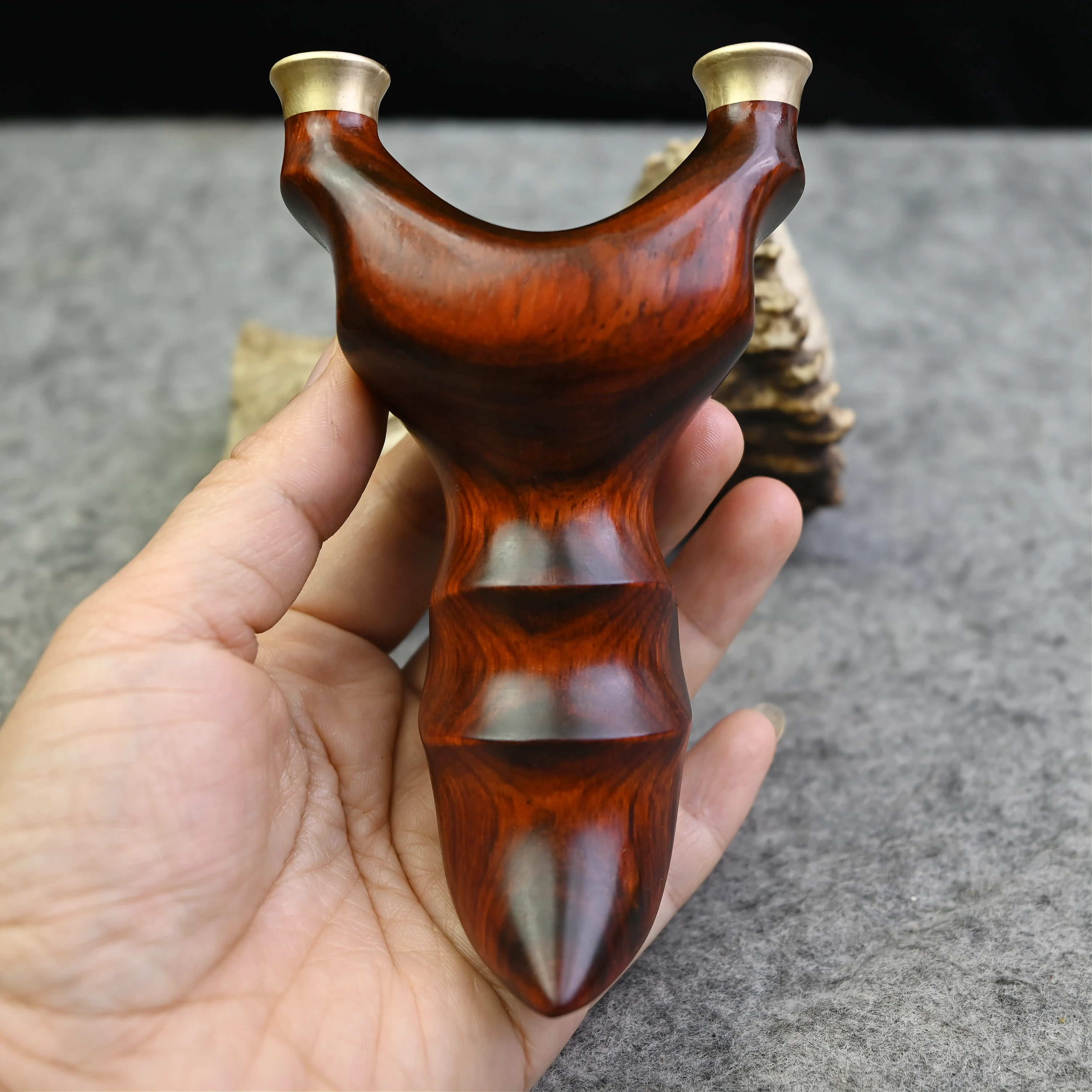
The listing currently does not label handedness. Ask before payment. A confident answer based on the exact piece is preferable to guessing from its pattern name.
The same applies to the Flying Tiger round-tip frame. Its narrower waist changes the contact points, but a slim outline does not prove that both hands will find it equally comfortable.
Grip style adds another question
A pinch hold concentrates contact high beneath the forks. A thumb-supported hold relies more on the shape under the thumb and the way the lower handle meets the palm. A frame may accommodate both, but the location of its curves still matters.
When asking about fit, include your preferred hold. If you have a comfortable existing frame, send its measurements or describe its handle shape. Avoid reducing the decision to hand length alone: palm breadth, finger placement, and the angle you naturally hold the frame all contribute.
Our pinch grip versus thumb support guide explains the contact areas worth comparing.
Can an asymmetric frame be used in the other hand?
Sometimes, but it should not be assumed. A modest contour may remain comfortable when reversed. A pronounced thumb shelf or palm swell may create pressure or force the wrist into an awkward position.
Do not solve a poor fit by removing wood yourself. Sanding can alter the finish, remove a useful reference surface, and affect areas the maker intended to retain. Ask whether a different piece or pattern would be more suitable.
A message that gets a useful answer
You can use this wording when contacting the workshop:
I hold the frame in my left hand and draw with my right. I prefer thumb support. Is this exact frame shaped for that hold? Could you confirm the handle thickness and show which face rests against the palm?
Change the hands and grip style to match your own setup. Add the product name so the answer refers to the pictured item rather than the pattern in general.
For the broader purchase decision, read how to choose a solid-wood slingshot. Fit starts with clear information: the holding hand, the intended contact surfaces, and the measurements of one actual frame.
Inspect the complete setup before use, wear eye protection, use a secure backstop, and comply with local law.