Wood grain describes the visible pattern and direction of the timber; a species name identifies the tree it came from. Both help describe a handmade wooden slingshot, but neither proves the soundness of the finished frame. Photographs can show appearance and some surface details, while reliable species identification requires more evidence than colour or figure alone.
Red-brown wood with dark streaks can look striking under a polished surface. It can also resemble several different timbers. That is where product descriptions need restraint: an attractive photograph is a reason to examine a piece, not enough evidence to give it a rare species name.
For a buyer, separating appearance from identification makes comparisons clearer. You can choose the grain you like while still asking precise questions about the material and construction.
What the grain tells you
The visible grain gives a frame much of its character. Lines may run quietly along a handle or turn across a shoulder as the surface changes direction. Darker streaks and colour transitions help distinguish one piece from another.
On a carved object, the pattern also changes with the viewing angle. A line that looks broad on the front may become narrow where the handle curves toward the side. That is one reason a full gallery is more useful than a single hero image.
Grain can help identify the exact item in a listing. It is less useful for judging hidden defects or predicting how every part of the frame behaves. A beautiful figure should not distract from a questionable line at a fork root.
What a species name adds
A confirmed species provides context about the material. It may help explain colour, density, working characteristics, or the finished weight. Those are tendencies, not a complete specification of the individual piece.
Even within one species, blanks vary. Moisture history, grain orientation, defects, and the way the frame was laid out all matter. A familiar name does not remove the need to inspect the particular wood used.
Our wood selection guide discusses why sound grain and suitable proportions should come before a ranking of exotic timbers.
Why photographs cannot settle identification
Lighting, white balance, surface finish, and screen settings all change the apparent colour of wood. A warm photograph can make brown timber look orange-red. A glossy highlight can hide fine pores, while a dark exposure may exaggerate streaks.
Several species can share similar visible features. Conversely, two examples of the same species can look surprisingly different. Confident identification from one polished product photograph is therefore a poor basis for a sales claim.
If species is important to your purchase, ask how it was identified. A maker may have a reliable material source or documented stock information. If that evidence is unavailable, a general hardwood description is more useful than an unsupported precise name.
Why some of our frames use a general material description
The 85 mm sculpted solid-wood slingshot is described as red-brown hardwood. Its photos show warm colour, darker grain, rounded tips, and a deep handle contour. The listing does not assign a specific botanical species.
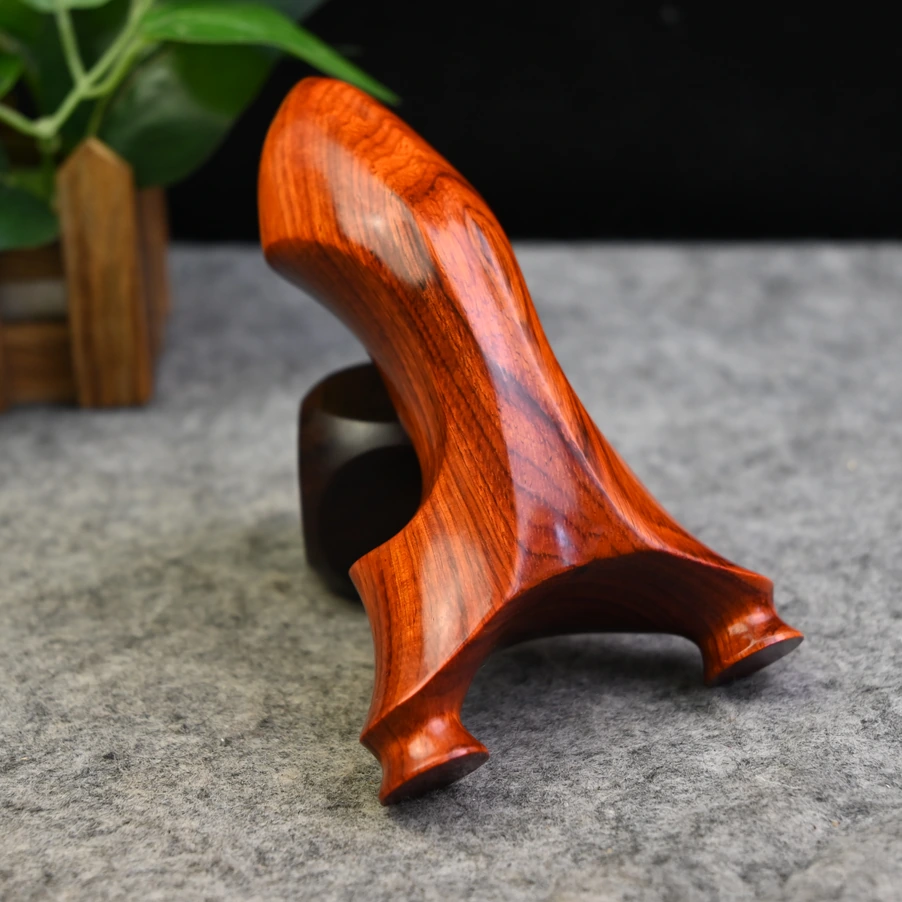
That leaves the buyer with verifiable details: the pictured item, its stated solid-wood construction, an 85 mm outer width, and 18 mm tips. If a particular species is a requirement, ask before ordering rather than treating red-brown colour as confirmation.
The Flying Tiger round-tip and Large Mantis also use general red-brown hardwood descriptions. Compare their shapes and measurements independently of the timber’s appearance.
Finish is another part of the picture
A polished surface changes the contrast of the grain and the way it catches light. That does not mean a high-gloss frame uses better wood than a satin one. It describes a surface treatment and presentation.
Photos cannot reliably tell you whether a finish is oil, wax, lacquer, or another coating. Use the written specification and ask when it is unclear, especially before choosing a maintenance product.
Our wooden frame care guide explains why applying an unknown polish is less useful than first establishing what finish is already present.
A better way to compare wooden frames
Begin with the actual photographs and published dimensions. Decide whether the handle profile suits the hold you prefer. Look for clear attachment details and ask about any mark you cannot interpret. Then consider whether the grain and colour appeal to you.
If species affects the decision, request its basis of identification. If weight matters, request the finished weight. One should not be used as a substitute for the other.
The best material description is one that stays within what is known. It gives the wood room to be individual while giving the buyer facts that can be checked. For the wider purchase decision, see how to choose a solid-wood slingshot.