Wooden and metal slingshot frames are often compared as if one material must defeat the other. That misses why people choose them. A machined metal frame can offer repeatable dimensions and a thin profile. A handmade wooden frame can place warmth, grain, and individually shaped volume in the hand.
Both can be well made. Both can be poorly designed. The useful comparison is not which material is “strongest” in isolation, but how the finished frame fits, attaches bands, handles wear, and communicates its condition.
Wood offers shape without a cold surface
Hardwood is pleasant to hold in cool weather and can be shaped into a full palm swell without feeling like a separate grip panel. The transition from fork shoulder to handle can be carved as one continuous form.
That freedom is important for asymmetric designs. Material can remain where the palm needs support and be removed where fingers need clearance. A handmade wooden slingshot does not have to look mirrored from every angle to feel balanced in one hand.
The trade-off is natural variation. Grain, density, and colour differ from piece to piece. Those differences are part of the appeal, but they also require the maker to inspect each blank and adapt the shaping.
Metal offers repeatability and thin sections
Machined or cast metal frames can reproduce a design very closely. Thin fork sections and precise mounting features are easier to repeat at scale, and hardware can be integrated into the frame from the beginning.
Bare metal may feel cold or slippery to some users, so many designs add scales, wraps, or textured coatings. Those additions can be effective, but they turn the grip into an assembly of materials rather than a single carved form.
Metal is not maintenance-free. Finishes can chip, threads can be damaged, and corrosion can begin where moisture is trapped. The appropriate care depends on the alloy and coating.
Weight depends on the design, not only the material
A small steel frame may feel dense, while a larger aluminium frame may be relatively light. Ebony and desert ironwood are far heavier than walnut. Simply comparing “wood” with “metal” does not predict the finished weight.
Balance matters as much as the number on a scale. Weight concentrated in the forks feels different from weight filling the palm. A frame that sits securely may feel lighter in use than a smaller one that requires constant grip adjustment.
Our guide to pinch grip versus thumb support discusses how handle shape changes that sense of control.
Wooden frames show their individuality
On a metal production frame, one catalogue photograph can reasonably represent thousands of nearly identical units. A one-of-one wooden slingshot needs photographs of the actual piece. Grain lines, colour, and hand-shaped contours are part of what the buyer is choosing.
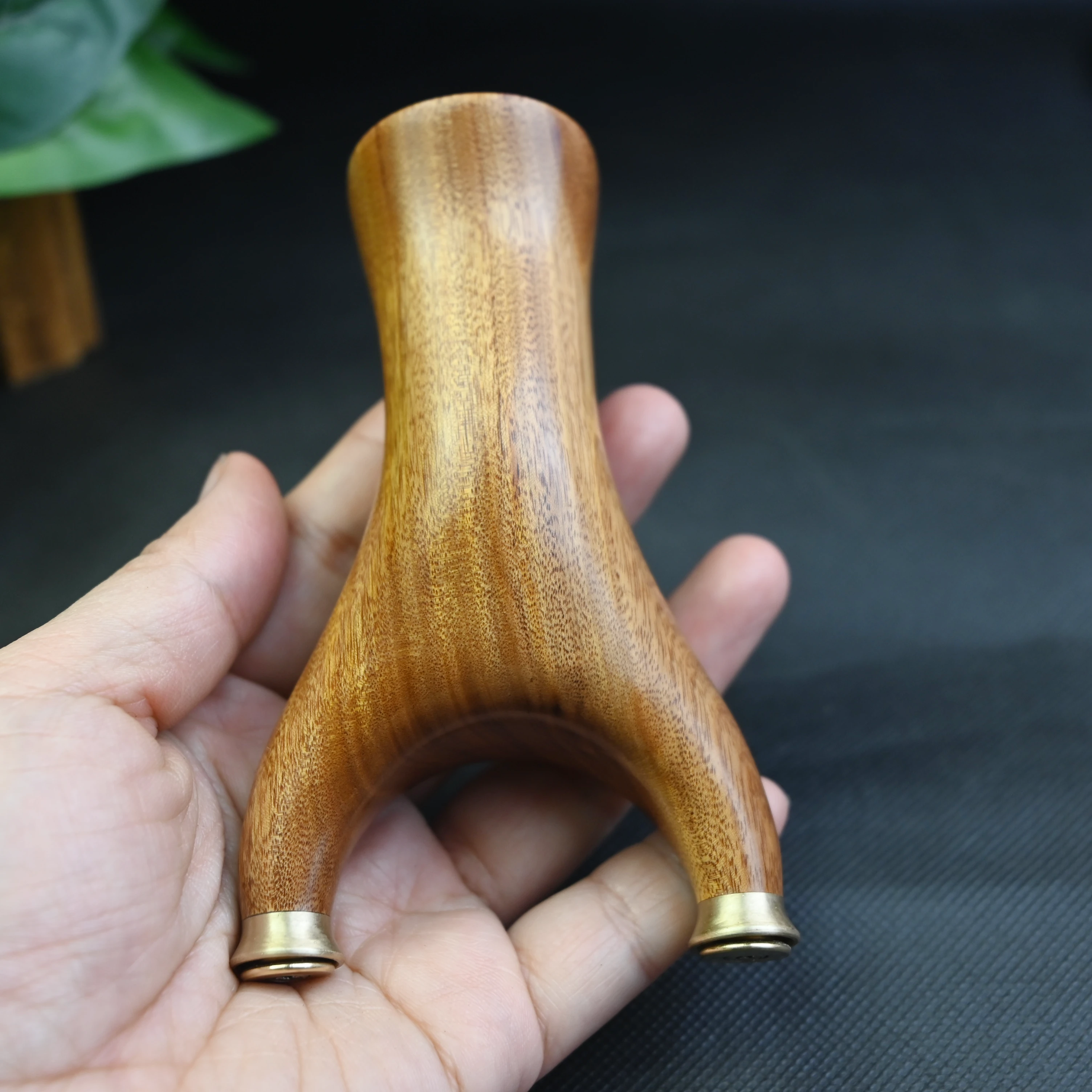
This also affects replacement. A mass-produced frame can usually be reordered in the same colour and size. A handmade wood frame may share a pattern with another piece, but the grain and small shaping decisions will not be duplicated exactly.
Inspection differs between materials
Wood should be checked around the fork roots, tips, and hardware for new lines, movement, or impact damage. Metal frames should be checked for bending, cracks, loose fasteners, damaged threads, and corrosion. Neither material makes inspection optional.
Surface damage needs context. A shallow mark in an oil finish may be cosmetic. A crack that catches a fingernail is not. A scratch in anodising may only alter appearance, while a line beginning at a threaded hole deserves closer attention.
When in doubt, stop using the frame and ask the maker or manufacturer. Continuing because the material has a reputation for strength is not a useful test.
Which frame should you choose?
If you have decided on solid wood, our solid-wood slingshot buying guide compares the current Flying Tiger, Large Mantis, and traditional-tip frames by measurements and handle profile.
Choose a wooden frame if you value natural material, a warm tactile surface, and the character of an individually shaped object. Choose a metal frame if exact repeatability, very thin geometry, or a particular integrated attachment system matters more to you.
Then look beyond material. Compare outer width, tip width, height, handle profile, attachment method, intended grip, and actual weight. A well-fitted frame in either material is more useful than a fashionable one that never settles in the hand.
At Zenith Fork Studio, wood is not an imitation of a metal product. It is the reason for the design: every frame begins with the grain, weight, and possibilities of one particular blank.
Inspect all equipment before use, wear eye protection, use a secure backstop, and comply with local law.